Skip to content
Deep product comparison

Workforce AI vs Glean

Glean combines enterprise search, assistants, agents, context, governance, and hundreds of connectors. Workforce AI is a much smaller purchase built around recurring client work. Glean is the enterprise knowledge and agent platform; Workforce AI is the operating role a small firm can understand without an AI program office.

Product facts reviewed August 26, 2026
Best fit at a glance
W
Winner: broader owner-side continuityWorkforce AI

Small firms that want the first useful client-work role without enterprise search deployment or agent-platform administration.

G
Glean

Enterprises that need permission-aware search, a shared context layer, agent building, orchestration, governance, and organization-wide adoption.

Short answer

Glean is enterprise Work AI infrastructure. Workforce AI is the small firm's client-work employee.

Glean is more powerful for enterprise knowledge, permissions, orchestration, and governed agent development. Workforce AI is more proportionate when a small team needs the inbox, supported meeting, approved follow-up, and next task handled.

Decision snapshot

The products are built from different starting points.

Official Glean page
Primary buyer
Workforce AI1-20 person firms
GleanEnterprise organizations
Core platform
Workforce AIClient operations
GleanEnterprise search, context, assistants, and agents
Connectors
Workforce AI60+ listed
Glean275+ stated for enterprise search
Commercial motion
Workforce AIPublic self-serve pricing
GleanDemo and enterprise sales
Capability matrix

Checks, limits, and gaps from the public evidence

A check means the capability is supported in the reviewed material. A partial mark means the fit is narrower or depends on configuration. A question mark means the vendor did not publish enough evidence to call it either way.

SupportedPartial or conditionalNot offeredNot publicly documented
Buying criterion
Workforce AI
Glean
Ready-made small-business roleCan a small firm start with an operating role instead of designing an agent platform?

AI employees are configured around recurring work for small professional-services and local-business teams.

Sources 1

Technically broad enough, but deployment and product scope are aimed at enterprise organizations.

Sources 5
Connected email draftingCan it use connected email context to prepare a useful reply?

Connects Gmail or Outlook and prepares drafts from the actual thread and account context.

Sources 13

Enterprise connectors and actions can work with communication systems.

Sources 5
Human review before client emailCan the owner inspect client-facing email before it goes out?

Client-facing email remains a draft for owner review and sending.

Sources 14

Permission-aware governance, deployment controls, and oversight are central.

Sources 5
Visible Zoom attendanceCan it join a supported Zoom call as a visible participant?

Can join supported Zoom meetings with the owner or from a supplied brief.

Sources 13

Meeting and collaboration data can be connected; visible Zoom attendance is not the primary product workflow.

Sources 5
Meeting-to-follow-up continuityCan meeting context carry into a reviewed email and next tasks?

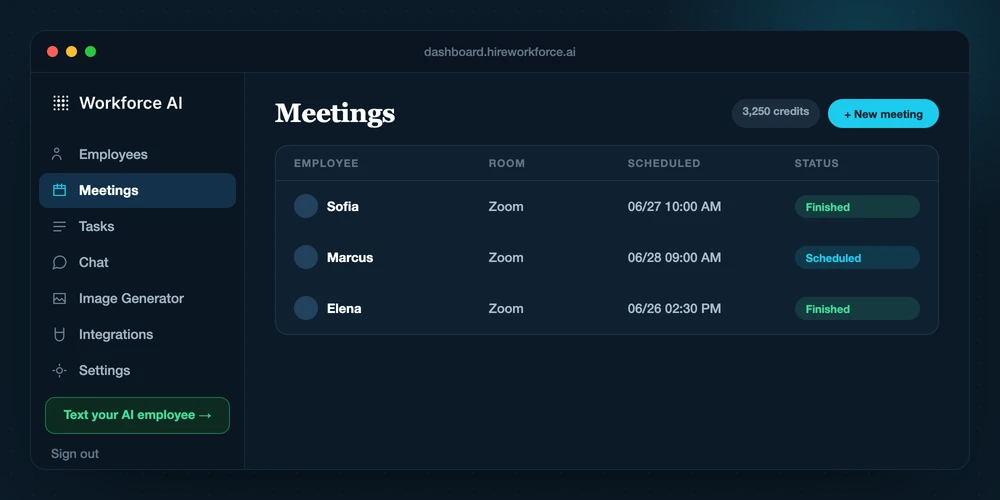
Turns supported meeting context into a write-up, draft, and explicit next steps inside the same work trail.

Sources 1

Agents can reason and act across enterprise workflows.

Sources 5
Recurring tasks and scheduling contextCan it keep routine work moving beyond a single answer?

Supports recurring tasks, scheduling context, reminders, and connected next steps.

Sources 1

Triggers, orchestration, and agent workflows support recurring work.

Sources 5
Cross-channel client memoryDoes the next interaction begin with the prior client context?

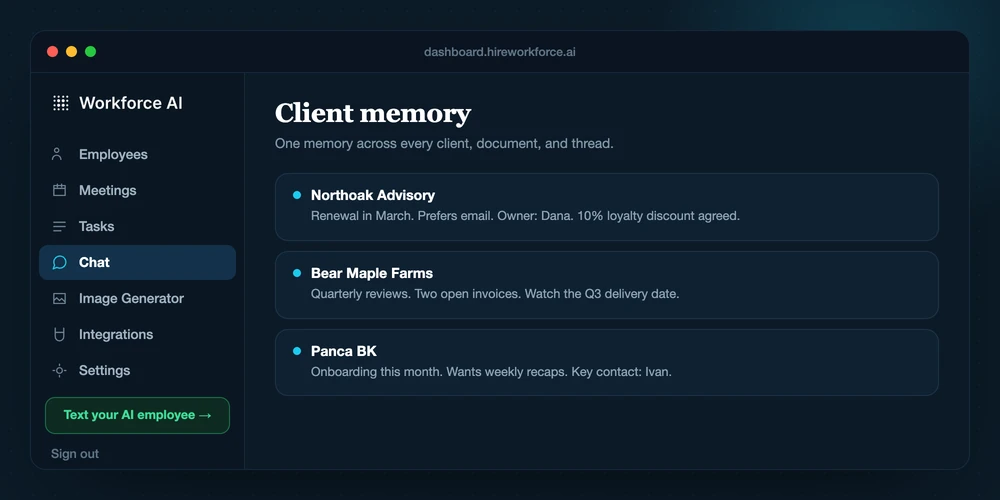
Keeps account-scoped context across connected email, meetings, chat, SMS, WhatsApp, tasks, and uploaded knowledge.

Sources 14

Enterprise Graph, Personal Graph, and indexed company context are central.

Sources 5
Owner SMS and WhatsAppCan the business owner work with the assistant outside the dashboard?

The account owner can work with the AI employee through supported SMS and WhatsApp channels.

Sources 13

Agents can be surfaced in Slack, Teams, ServiceNow, Zendesk, browser, and other enterprise systems.

Sources 5
General agent builderIs the product a broad environment for designing arbitrary agents?

Workforce AI configures roles and workflows, but it is not sold as a general-purpose agent development platform.

Sources 1

No-code and low-code agent building, orchestration, observability, and APIs are core.

Sources 5
Autonomous customer calls or chatCan it independently answer customer phone calls or website chats today?

The current product is owner-side. Browser voice is available, but autonomous customer phone answering and customer-facing website support are outside the current product boundary.

Sources 1

Customer-service agents can be built, but local-business phone answering is not a turnkey package.

Sources 5
Specialist vertical workflowDoes it ship with a workflow built only for one profession or front-office system?

Industry configurations support common workflows, while licensed professional judgment and specialist systems stay with the firm.

Sources 1

The platform can support many departments but is horizontal enterprise infrastructure.

Sources 5
Public entry pricingCan a buyer see a starting price before a sales call?

The email drafter is free and full AI employee plans start at $99 per user per month.

Sources 2

Standard public plan prices are not shown; the motion is demo-led.

Sources 5
Where each wins

Pick the product whose strongest lane matches the bottleneck.

Choose Workforce AI when

The client trail is the work.

  • The firm wants a ready owner-side workflow instead of an agent-building project.
  • Email, supported Zoom, follow-up, tasks, and client memory should share one trail.
  • Client-facing email should stop for a person to review and send.
Choose Glean when

Its specialist lane is the work.

  • Enterprise search and permission-aware company context are the primary problem.
  • The organization needs agent certification, governance, observability, and broad deployment.
  • Hundreds or thousands of employees will use one platform.
Workflow test

A firm wants one client workflow; an enterprise wants one context plane.

Those are different architecture decisions. Workforce AI answers the first with a managed role. Glean answers the second with enterprise search, context, and agents.

Step
With Workforce AI
With Glean
01

Connect the owner's supported email, calendar context, and other selected tools.

Connect enterprise systems, permissions, and identity.

02

Give the AI employee a recurring job, a real thread, or a supported Zoom meeting.

Index company knowledge and establish the shared context layer.

03

Review the prepared email, meeting write-up, task, or sensitive next step.

Build, certify, deploy, and orchestrate agents across teams.

04

Carry the approved context into the next client touch instead of rebuilding it from scratch.

Monitor adoption, errors, feedback, cost, and ROI through enterprise controls.

Before you buy

Run the same job through both products.

Do not score a demo on the first answer. Score the complete job, the manual handoffs, the review point, and what survives into the next interaction.

  1. 01

    Which exact job does Glean complete without a manual handoff?

  2. 02

    Which actions require approval, and where is the approval history visible?

  3. 03

    How much setup and ongoing maintenance does a reliable workflow require?

  4. 04

    What is the full price after usage, integrations, implementation, and support?

Research method

Primary sources, dated facts, no invented gaps.

We reviewed official product, documentation, help-center, and pricing material on August 26, 2026. When a vendor did not publicly document a capability, the matrix says that. It does not turn silence into an X.

  1. 1Workforce AI product overviewWorkforce AI
  2. 2Workforce AI pricingWorkforce AI
  3. 3Workforce AI integrationsWorkforce AI
  4. 4Workforce AI security and controlsWorkforce AI
  5. 5Glean AI agentsGlean
  6. 6Glean agent builderGlean
  7. 7Glean Agents documentationGlean
Questions

Questions about Workforce AI and Glean

Reviewed August 26, 2026.

Is Workforce AI a replacement for Glean?

Only when the job matches. Glean is the better choice for enterprises that need permission-aware search, a shared context layer, agent building, orchestration, governance, and organization-wide adoption. Workforce AI is the better choice when connected email, supported Zoom, reviewed follow-up, tasks, scheduling context, and client memory need to move together.

Which product is easier for a small business to start with?

Workforce AI is packaged for small firms and publishes a free email drafter plus paid AI employee plans. Glean may be easy to start when its specialist job is exactly what the business needs, but broader platforms usually require more workflow design or implementation.

Can a business use Workforce AI and Glean together?

Yes. Keep Glean for the specialist or platform job it handles best, and use Workforce AI for the owner-side client communication and follow-through around it. Define separate triggers and systems of record so the tools do not duplicate actions.

How do the prices compare?

Workforce AI offers a free email drafter and paid AI employee plans starting at $99 per user per month. Confirm Glean's current commercial terms, usage charges, implementation, integrations, and support before purchase.

How was this comparison researched?

The comparison uses official product, documentation, help-center, and pricing sources listed on this page. Facts were reviewed on August 26, 2026. A missing public claim is marked as not publicly documented instead of being treated as a missing feature.
Decide with real work

Compare the products on one workflow you do every week.

A feature table is useful. A real inbox, meeting, or follow-up process makes the difference obvious.