The client trail is the work.
- The job belongs to a client account, not a personal to-do list.
- Supported Zoom context must turn into a reviewed email and task.
- The team wants one business memory across owner-side channels.
Poke is a personal assistant that lives in the messaging apps people already use. Workforce AI is built around the recurring client work of a small business. Both can reduce daily admin, but they begin with different lives and carry different responsibilities.
Small professional-services and local-business teams that want email, supported Zoom meetings, reviewed follow-up, tasks, scheduling context, and client memory to stay connected.
Individuals who want a personal assistant in Apple Messages, Telegram, WhatsApp, or RCS for email, calendar, reminders, research, and real-world errands.
Poke makes sense when the operating surface is your phone and the work mixes calendar, inbox, reminders, research, and personal errands. Workforce AI makes sense when the unit of work is a client: what was emailed, what happened in a supported Zoom meeting, what needs approval, and what comes next.
A check means supported. A dash means partial or conditional. A question mark means the vendor did not publish enough to decide.
AI employees are configured around recurring work for small professional-services and local-business teams.
Useful to business owners, but the public product is framed as a personal assistant rather than a small-business operating role.
Connects Gmail or Outlook and prepares drafts from the actual thread and account context.
Connects email and can help read, organize, and act on inbox work.
Client-facing email remains a draft for owner review and sending.
The user remains in the messaging conversation, but a business-specific client-email approval flow is not publicly documented.
Can join supported Zoom meetings with the owner or from a supplied brief.
A visible meeting participant for Zoom is not part of the public product description.
Turns supported meeting context into a write-up, draft, and explicit next steps inside the same work trail.
Can use email, calendar, reminders, and messaging together, but a meeting-to-reviewed-client-follow-up workflow is not the stated product lane.
Supports recurring tasks, scheduling context, reminders, and connected next steps.
Handles calendar work, reminders, and scheduled help.
Keeps account-scoped context across connected email, meetings, chat, SMS, WhatsApp, tasks, and uploaded knowledge.
Learns preferences and context for personal assistance; the public material does not describe a client-account memory model.
The account owner can work with the AI employee through supported SMS and WhatsApp channels.
Runs in WhatsApp and other consumer messaging surfaces.
Workforce AI configures roles and workflows, but it is not sold as a general-purpose agent development platform.
Poke is a finished assistant rather than a general agent builder.
The current product is owner-side. Browser voice is available, but autonomous customer phone answering and customer-facing website support are outside the current product boundary.
The product is not presented as an autonomous customer call center or website support system.
Industry configurations support common workflows, while licensed professional judgment and specialist systems stay with the firm.
No profession-specific workflow is the center of the public product.
The email drafter is free and full AI employee plans start at $99 per user per month.
Free, Pro, and Ultra prices are public.
These are real Workforce AI product views. The point is continuity: useful context enters once, then carries into the draft, follow-up, or next task.
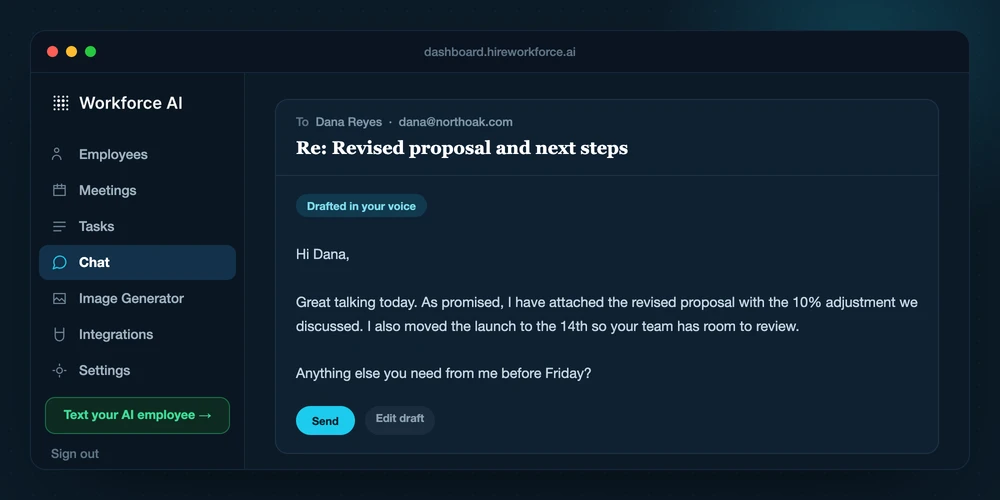
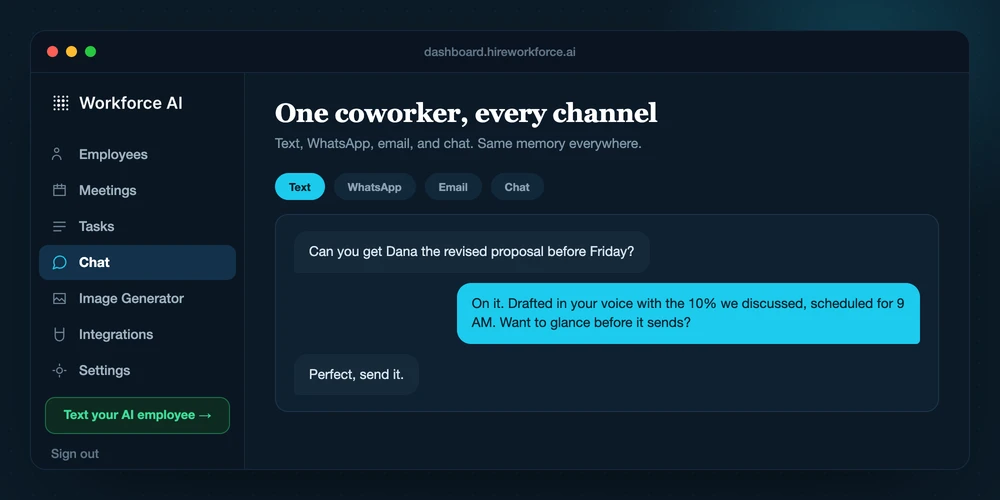
The useful test is what happens after the call. Workforce AI is designed to connect the meeting record, client history, draft, and task. Poke is designed to help an individual handle the inbox, calendar, reminders, and messages around the day.
Connect the owner's supported email, calendar context, and other selected tools.
Message Poke from a supported consumer messaging app and connect personal services.
Give the AI employee a recurring job, a real thread, or a supported Zoom meeting.
Ask it to handle the inbox, calendar, reminder, research, or personal task.
Review the prepared email, meeting write-up, task, or sensitive next step.
Continue the task in the messaging conversation and confirm actions as needed.
Carry the approved context into the next client touch instead of rebuilding it from scratch.
Use the resulting reminder, message, or completed Poke Human task in the rest of the day.
Do not score a demo on the first answer. Score the complete job, the manual handoffs, the review point, and what survives into the next interaction.
Will the assistant hold account-level client context or personal preferences?
Does a meeting become a reviewed client draft without manual copying?
Which actions require confirmation and where is that history visible?
Is the buying decision personal convenience or business workflow coverage?
Reviewed August 26, 2026.
Only when the job matches. Poke is the better choice for individuals who want a personal assistant in Apple Messages, Telegram, WhatsApp, or RCS for email, calendar, reminders, research, and real-world errands. Workforce AI is the better choice when connected email, supported Zoom, reviewed follow-up, tasks, scheduling context, and client memory need to move together.
Workforce AI is packaged for small firms and publishes a free email drafter plus paid AI employee plans. Poke may be easy to start when its specialist job is exactly what the business needs, but broader platforms usually require more workflow design or implementation.
Yes. Keep Poke for the specialist or platform job it handles best, and use Workforce AI for the owner-side client communication and follow-through around it. Define separate triggers and systems of record so the tools do not duplicate actions.
Workforce AI offers a free email drafter and paid AI employee plans starting at $99 per user per month. Poke: Free; Pro $19/month; Ultra $199/month. Confirm usage, implementation, integration, and support costs before purchase.
The comparison uses official product, documentation, help-center, and pricing sources listed on this page. Facts were reviewed on August 26, 2026. A missing public claim is marked as not publicly documented instead of being treated as a missing feature.
A feature table is useful. A real inbox, meeting, or follow-up process makes the difference obvious.