Skip to content
Product comparison

Workforce AI vs Teammates.ai

Teammates.ai offers named AI employees for customer service, sales, and hiring. Workforce AI lets a small business configure AI employees around its own recurring client work across connected email, supported Zoom meetings, follow-up, scheduling context, tasks, and memory. Choose pre-defined departments or a role shaped around your workflow.

Product facts reviewed August 26, 2026
Best fit at a glance
W
Winner: configurable client-work continuityWorkforce AI

Small firms that want configurable employees to carry their own email, supported Zoom, follow-up, scheduling, task, and client-memory workflows.

T
Teammates.ai

Businesses that want pre-defined AI employees focused on customer service, sales, or hiring with a credit-based usage model.

Short answer

Teammates.ai packages departments. Workforce AI follows the client trail.

Teammates.ai makes the buying decision concrete with named employees for customer service, sales, and hiring. Workforce AI is broader across the owner's client operations and keeps supported meeting, inbox, follow-up, task, and memory context connected. The right test is one real job: how much setup is required, what the product returns, what still needs a person, and whether the context survives the next step.

Decision snapshot

The products are built from different starting points.

Role model
Workforce AIConfigured around the firm
Teammates.aiNamed department employees
Primary jobs
Workforce AIClient operations
Teammates.aiCustomer service, sales, and hiring
Usage
Workforce AIPlan allowances and credits
Teammates.aiShared credit model
Pricing
Workforce AIFree drafter and paid plans
Teammates.aiFree entry and paid credit tiers
Capability matrix

Checks, limits, and gaps from the public evidence

A check means supported. A dash means partial or conditional. A question mark means the vendor did not publish enough to decide.

SupportedPartial or conditionalNot offeredNot publicly documented
Buying criterion
Workforce AI
Teammates.ai
Ready-made small-business role

AI employees are configured around recurring work for small professional-services and local-business teams.

Named employees provide a direct role-based starting point.

Connected email drafting

Connects Gmail or Outlook and prepares drafts from the actual thread and account context.

Role employees can work on supported communication tasks.

Human review before client email

Client-facing email remains a draft for owner review and sending.

Buyers should verify approval, escalation, and audit behavior for the selected employee.

Visible Zoom attendance

Can join supported Zoom meetings with the owner or from a supplied brief.

Visible Zoom attendance is not established in the reviewed overview.

Meeting-to-follow-up continuity

Turns supported meeting context into a write-up, draft, and explicit next steps inside the same work trail.

Sales and service roles can execute follow-up in their supported channels.

Recurring tasks and scheduling context

Supports recurring tasks, scheduling context, reminders, and connected next steps.

Employees perform continuing role work using shared credits.

Cross-channel client memory

Keeps account-scoped context across connected email, meetings, chat, SMS, WhatsApp, tasks, and uploaded knowledge.

Employee and workspace context support ongoing role execution.

Owner SMS and WhatsApp

The account owner can work with the AI employee through supported SMS and WhatsApp channels.

Customer service and sales roles operate through supported communication channels.

General agent builder

Workforce AI configures roles and workflows, but it is not sold as a general-purpose agent development platform.

Named and custom employees provide role flexibility without being a general developer platform.

Autonomous customer calls or chat

The current product is owner-side. Browser voice is available, but autonomous customer phone answering and customer-facing website support are outside the current product boundary.

Customer-service employees are a central packaged offer.

Specialist vertical workflow

Industry configurations support common workflows, while licensed professional judgment and specialist systems stay with the firm.

The product goes deep into customer service, sales, and hiring roles.

Public entry pricing

The email drafter is free and full AI employee plans start at $99 per user per month.

Free entry and public paid credit tiers are documented.

Inside Workforce AI

See the work, not another feature claim.

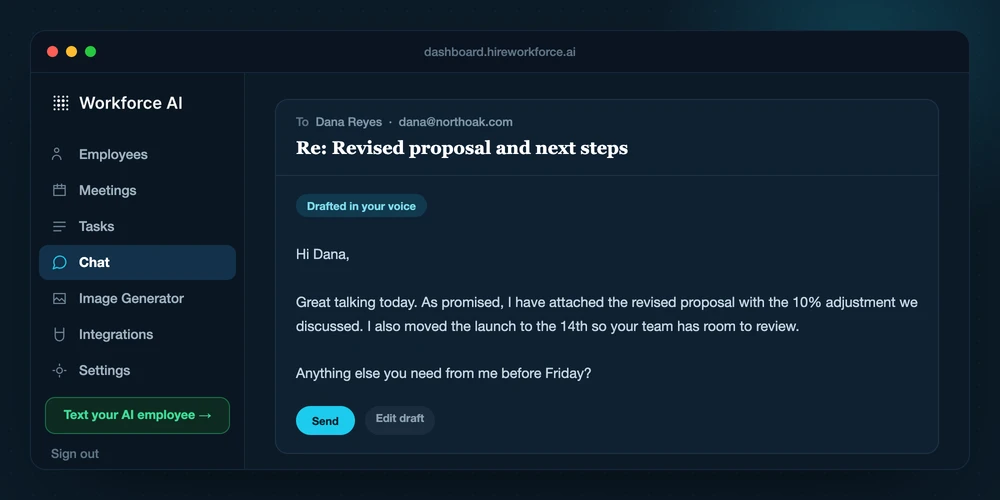
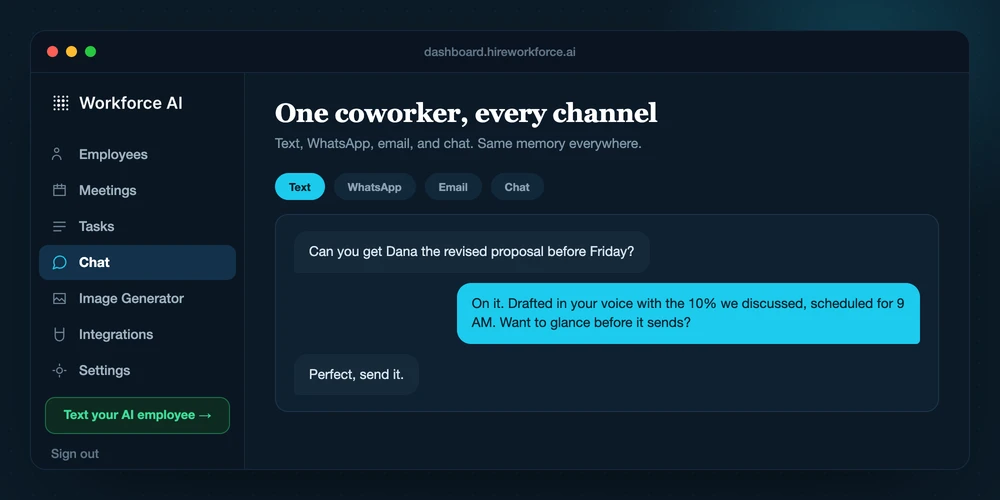
These are real Workforce AI product views. The point is continuity: useful context enters once, then carries into the draft, follow-up, or next task.

Workforce AI preparing an email draft from a client thread
A client-ready draft grounded in the real thread.
Workforce AI channel workspace for email, SMS, WhatsApp, and chat
One work trail across the channels the owner uses.
Where each wins

Pick the product whose strongest lane matches the bottleneck.

Choose Workforce AI when

The client trail is the work.

  • The firm wants a ready owner-side workflow instead of an agent-building project.
  • Email, supported Zoom, follow-up, tasks, and client memory should share one trail.
  • Client-facing email should stop for a person to review and send.

Choose Teammates.ai when

Its specialist lane is the work.

  • A pre-packaged customer service, sales, or hiring employee is the exact need.
  • Customer-facing role execution matters more than a supported Zoom workflow.
  • The shared credit model fits the expected volume.
Workflow test

A buyer wants a named role, but the work crosses department lines.

Teammates.ai is clearer when the job stays inside one packaged department. Workforce AI is clearer when the same client context moves from meeting to inbox to task and back again.

Step
With Workforce AI
With Teammates.ai
01

Connect the owner's supported email, calendar context, and other selected tools.

Choose the named Teammates.ai employee closest to the department job.

02

Give the AI employee a recurring job, a real thread, or a supported Zoom meeting.

Connect the supported channels and provide workspace context.

03

Review the prepared email, meeting write-up, task, or sensitive next step.

Let the employee perform role tasks against the shared credit pool.

04

Carry the approved context into the next client touch instead of rebuilding it from scratch.

Review results, escalations, and remaining credit usage.

Before you buy

Run the same job through both products.

Do not score a demo on the first answer. Score the complete job, the manual handoffs, the review point, and what survives into the next interaction.

  1. 01

    Which exact job does Teammates.ai complete without a manual handoff?

  2. 02

    Which actions require approval, and where is the approval history visible?

  3. 03

    How much setup and ongoing maintenance does a reliable workflow require?

  4. 04

    What is the full price after usage, integrations, implementation, and support?

Questions

Questions about Workforce AI and Teammates.ai

Reviewed August 26, 2026.

Is Workforce AI a replacement for Teammates.ai?

That depends on the job. Teammates.ai may be the better specialist for its core category. Workforce AI is the better fit when email, meetings, follow-up, tasks, approvals, scheduling, and client context need to move together.

Can a team use Workforce AI and Teammates.ai together?

Yes. Keep Teammates.ai for the work it handles best and give Workforce AI the recurring communication and follow-up around it. Test one real workflow before paying for overlapping capabilities.

How current is this comparison?

Product and public pricing facts were reviewed on August 26, 2026. Vendors change plans, limits, and features, so confirm a time-sensitive buying detail before purchase.

Decide with real work

Compare the products on one workflow you do every week.

A feature table is useful. A real inbox, meeting, or follow-up process makes the difference obvious.