The client trail is the work.
- The avatar must join a real supported meeting and continue the work.
- Email, follow-up, tasks, and client memory matter after the appearance.
- The buyer wants an employee rather than a video studio.
Synthesia creates polished AI videos with avatars, voices, translation, brand controls, and collaboration. Workforce AI puts an avatar to work inside a supported Zoom meeting, then carries the conversation into email, follow-up, tasks, approvals, and client memory. Pick the video studio or the employee in the meeting.
Businesses that want a visible AI employee in supported Zoom meetings and the work after them: recaps, drafts, tasks, approvals, scheduling, and memory.
Teams producing training, enablement, marketing, product, localization, and internal videos with AI avatars and brand controls.
The overlap is the face on screen. The jobs are different. Synthesia is a production platform for scripted and localized video at scale. Workforce AI is an operating employee whose visible avatar joins a live supported Zoom call and then works through the resulting communication and tasks. Buy the studio for content. Buy the employee for the job.
A check means supported. A dash means partial or conditional. A question mark means the vendor did not publish enough to decide.
AI employees are configured around recurring work for small professional-services and local-business teams.
Synthesia is a video-production platform rather than a ready small-business operating role.
Connects Gmail or Outlook and prepares drafts from the actual thread and account context.
Connected client-email drafting is outside the core product.
Client-facing email remains a draft for owner review and sending.
Video review and collaboration are supported, but this is not a client-operation approval queue.
Can join supported Zoom meetings with the owner or from a supplied brief.
Synthesia avatars present produced content rather than joining Zoom as an interactive employee.
Turns supported meeting context into a write-up, draft, and explicit next steps inside the same work trail.
Meeting-to-client follow-up is outside the video-production workflow.
Supports recurring tasks, scheduling context, reminders, and connected next steps.
Recurring operational task execution is not the product lane.
Keeps account-scoped context across connected email, meetings, chat, SMS, WhatsApp, tasks, and uploaded knowledge.
A cross-channel client memory is not part of the public platform model.
The account owner can work with the AI employee through supported SMS and WhatsApp channels.
Owner SMS and WhatsApp are outside the video studio experience.
Workforce AI configures roles and workflows, but it is not sold as a general-purpose agent development platform.
Teams build videos, avatars, voices, templates, translations, quizzes, and interactive experiences.
The current product is owner-side. Browser voice is available, but autonomous customer phone answering and customer-facing website support are outside the current product boundary.
Interactive avatars and video agents can support customer experiences, subject to product and plan availability.
Industry configurations support common workflows, while licensed professional judgment and specialist systems stay with the firm.
Templates and learning features fit training and enablement, while the platform remains horizontal.
The email drafter is free and full AI employee plans start at $99 per user per month.
Free, Starter, Creator, and Enterprise plan terms are published.
These are real Workforce AI product views. The point is continuity: useful context enters once, then carries into the draft, follow-up, or next task.
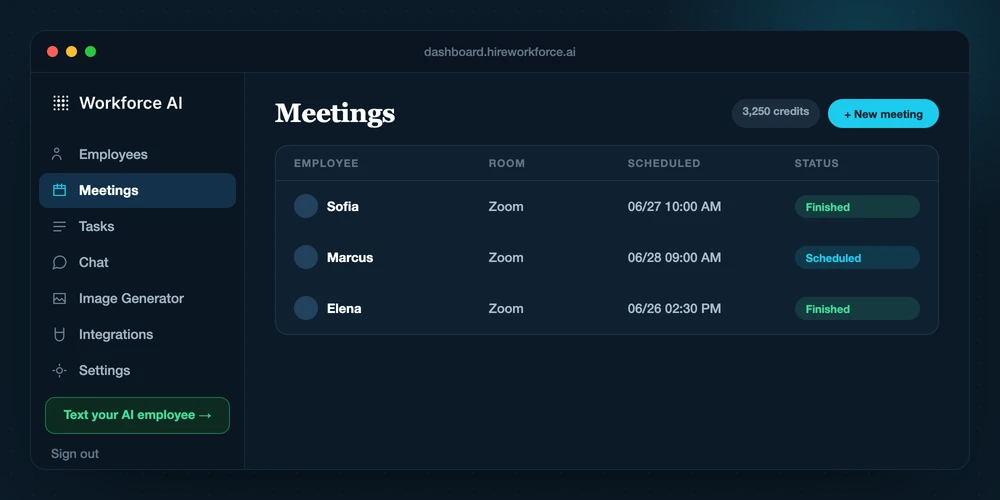
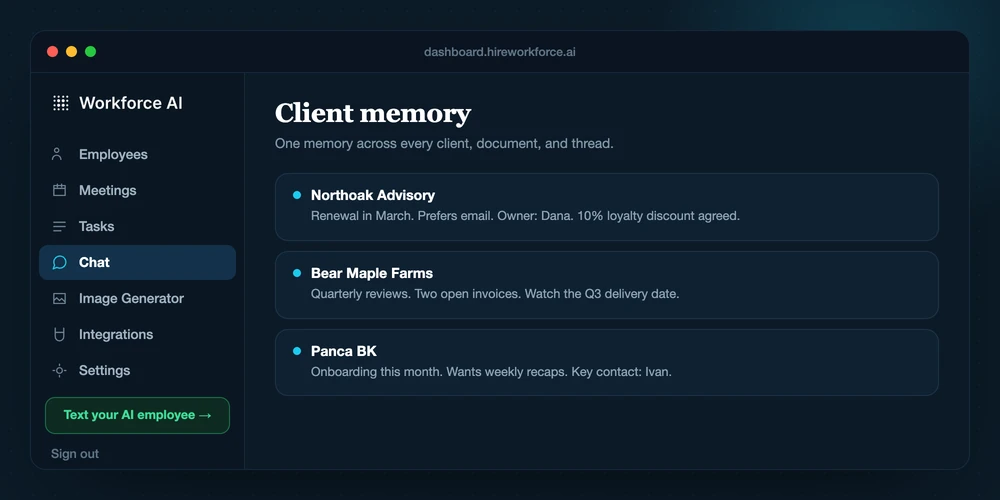
Synthesia is the stronger studio. Workforce AI uses the avatar as one interface for an employee that also works through the meeting aftermath.
Connect the owner's supported email, calendar context, and other selected tools.
Choose an avatar, voice, template, script, language, and brand settings.
Give the AI employee a recurring job, a real thread, or a supported Zoom meeting.
Generate and edit the video with the relevant collaboration controls.
Review the prepared email, meeting write-up, task, or sensitive next step.
Publish, embed, download, or distribute the finished content.
Carry the approved context into the next client touch instead of rebuilding it from scratch.
Track viewing and update the content when the message changes.
Do not score a demo on the first answer. Score the complete job, the manual handoffs, the review point, and what survives into the next interaction.
Which exact job does Synthesia complete without a manual handoff?
Which actions require approval, and where is the approval history visible?
How much setup and ongoing maintenance does a reliable workflow require?
What is the full price after usage, integrations, implementation, and support?
Reviewed August 26, 2026.
That depends on the job. Synthesia may be the better specialist for its core category. Workforce AI is the better fit when email, meetings, follow-up, tasks, approvals, scheduling, and client context need to move together.
Yes. Keep Synthesia for the work it handles best and give Workforce AI the recurring communication and follow-up around it. Test one real workflow before paying for overlapping capabilities.
Product and public pricing facts were reviewed on August 26, 2026. Vendors change plans, limits, and features, so confirm a time-sensitive buying detail before purchase.
A feature table is useful. A real inbox, meeting, or follow-up process makes the difference obvious.